

Last Updated: October 23, 2026
Quick Summary
Rental compliance in Florida is a stack of overlapping requirements from the state, county, city, and often a private HOA, and the strictest rule wins. You need state DBPR registration, a local business tax receipt, county and city licenses where required, plus sales and tourist tax remittance.
- A single property can carry three or four active registrations, each with its own renewal date.
- Booking platforms may not remit the county tourist development tax, so confirm what they actually cover.
- Saltwater pools follow the same barrier and self-latching gate rules as chlorinated pools.
- HOA and deed restrictions override local rules whenever they are stricter, including minimum lease lengths.
- Review rental compliance at least once a year and re-check local ordinances, which cities do revise.
Table of Contents
- Who This Florida Short Term Rental Compliance Guide Is For
- Florida Vacation Rental License Requirements
- Florida Short-Term Rental Taxes You Must Collect and Remit
- Florida Short-Term Rental Compliance Checklist
- Florida Pool Safety Requirements for Vacation Rentals
- HOA and Deed Restrictions That Override Local Rules
- How Often to Review Your Rental Compliance
- Frequently Asked Questions
Who This Florida Short Term Rental Compliance Guide Is For
This Florida short term rental compliance guide is for anyone who owns, manages, or books a vacation home on the Gulf Coast, and for travelers who want to know the property they reserve actually meets the rules. At Cape Coral Vacation Homes & Rentals LLC, we deal with these requirements every week, and we wrote this to answer the question we hear most: what does a compliant rental actually look like?
Rental compliance in Florida is not one rule. It is a stack of overlapping requirements from the state, the county, the city, and often a private HOA. Miss one layer and the whole stack can come down.
Below, we walk through licensing, taxes, pool barriers, and the deed restrictions that quietly override everything else. The order matters, because a permit you hold at the state level means nothing if your neighborhood covenant bans rentals outright.
Compliance is layered, not singular. State registration, local business tax receipts, county and city licenses, and HOA covenants all apply at once, and the strictest one wins.
Florida Vacation Rental License Requirements
Florida vacation rental license requirements begin at the state level and multiply as you move down to the county and city. The state registration and local business tax receipt are the foundation; local licenses sit on top of them.
State Registration and Local Business Tax Receipts
Florida requires vacation rental operators to register with the Department of Business and Professional Regulation and to hold a local business tax receipt from the county or city where the property sits. The Florida DBPR vacation rental licensing portal is where the state registration is filed and renewed.
A common mistake is treating the state registration as the finish line. It is the starting line. The local business tax receipt is a separate filing with a separate office, and operating without it is one of the most frequent compliance failures we see.
County and City Licensing in Lee County and Cape Coral
Properties in our area face an additional layer: Lee County and the City of Cape Coral each maintain their own licensing and inspection expectations for short-term rentals. The exact forms and renewal cycles change, so confirm current requirements directly with the City of Cape Coral business tax and licensing office before you list or renew.
For owners, this means a single property can carry three or four active registrations at once. Track each one with its own renewal date. A lapsed local license does not pause your bookings, but it does expose you to penalties.
Florida Short-Term Rental Taxes You Must Collect and Remit
Florida short-term rental taxes are collected at two levels: state sales tax and the local tourist development or resort tax collected by the county. Both apply to stays under the state’s transient rental threshold, and both must be remitted on a set schedule.
The state sales tax is filed through the Florida Department of Revenue. The county tourist tax is filed separately, and the rate varies by county. In Lee County, confirm the current rate and filing cadence with the Lee County Tourist Development Council before your first booking.
| Tax or Fee | Collected By | Filed With | Watch For |
|---|---|---|---|
| State sales tax | Host or manager | Florida Dept. of Revenue | Filing frequency based on volume |
| County tourist development tax | Host or manager | County tax collector | Rate varies by county |
| Local business tax | Operator | City or county | Separate from sales tax |
| State rental registration | Operator | DBPR | Renewal cycle |
Booking platforms sometimes collect and remit some taxes on your behalf, but not always all of them. Assuming the platform handled the county tourist tax is a common and expensive error.
Florida Short-Term Rental Compliance Checklist
A Florida short-term rental compliance checklist keeps the moving parts in one place. Use this as a working list, and revisit it every time a rule or a renewal date changes.
- Active state vacation rental registration with DBPR
- Current local business tax receipt for the property’s city or county
- County and city short-term rental license, if required locally
- State sales tax account open and filing on schedule
- County tourist development tax registered and remitting
- Pool barrier and gate inspection documented
- HOA rental approval on file, with any lease-length minimums noted
- Insurance policy that covers short-term rental use
- Renewal dates logged on a calendar with reminders set
For owners who would rather not manage this themselves, professional management is the practical answer. Cape Coral Vacation Homes & Rentals LLC handles registrations, tax remittance, and renewal tracking for the properties we manage, so owners are not chasing four separate filing deadlines. You can see the waterfront vacation homes in Cape Coral we manage as examples of fully documented, compliant properties.
Florida Pool Safety Requirements for Vacation Rentals
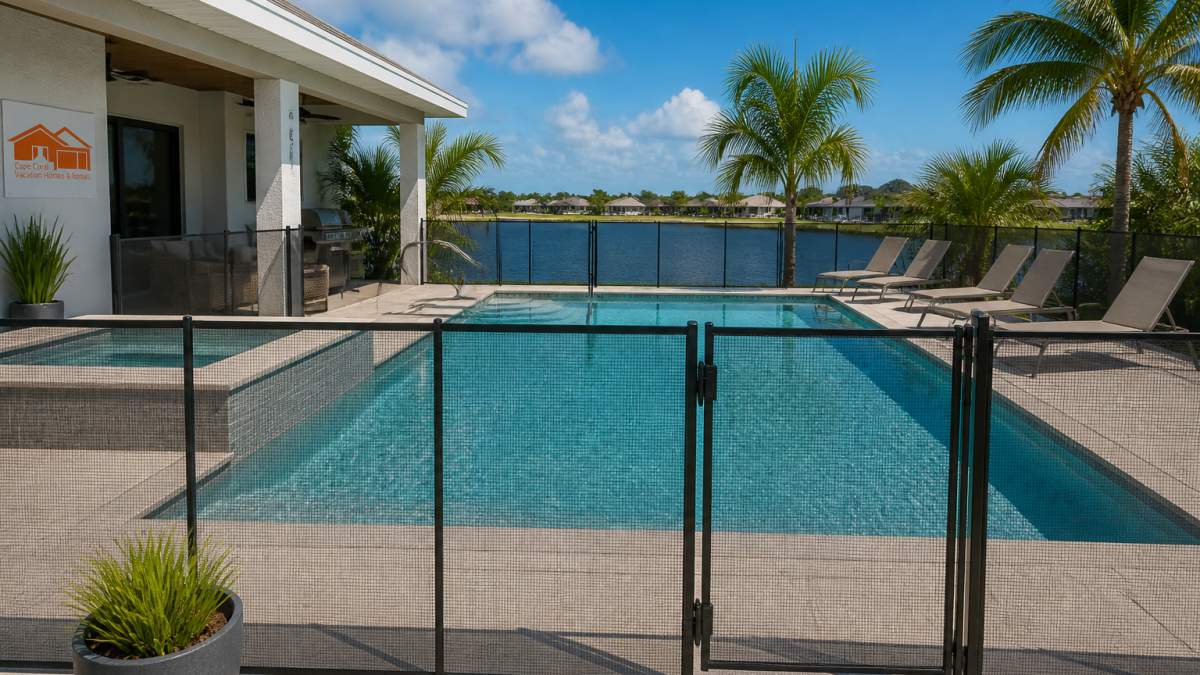
Florida pool safety requirements for vacation rentals center on one thing: a barrier that keeps unsupervised children out of the water. A private pool at a rental property must have a compliant barrier, and a self-closing, self-latching gate is the standard most inspectors look for. Properties that operate under a lodging license may also need to adhere to broader commercial pool safety requirements to ensure that all aquatic facilities remain fully compliant with state operational standards.
Saltwater Pools and Barrier Rules
Saltwater pools follow the same barrier rules as chlorinated pools. The sanitation method changes nothing about the fence, gate, or alarm requirements. A common misconception is that a saltwater system is somehow exempt; it is not.
What most guides miss is the gate hardware. A gate that closes but does not latch on its own fails inspection, and it fails for a reason: a child can follow an adult through an unlatched gate in seconds. Check the self-latching mechanism monthly, and replace the hinges the moment they start to stick.
Test the gate by letting it swing shut from a half-open position. If it does not latch every single time, adjust or replace the hardware before your next guest arrives.
HOA and Deed Restrictions That Override Local Rules
HOA and deed restrictions override local rules whenever they are stricter. A property can hold every state, county, and city license and still be barred from short-term renting by a covenant recorded decades ago.
Before you list, read the deed restrictions and the HOA rules for minimum lease length, occupancy caps, and parking limits. Some communities require a minimum stay of a week or more, which changes your entire rental model. Others cap the number of rentals per year.
If you are a guest, this is why booking through a manager who knows the neighborhood matters. Our Villa High Tide and Villa Turtle Paradise sit in communities where the rental rules are already cleared, so you are not the one discovering a restriction at check-in. Long-term stays of four or eight weeks are welcome, and they often fit HOA minimums more comfortably than nightly bookings.
How Often to Review Your Rental Compliance
Review rental compliance at least once a year, and again any time a rule changes or you change how you rent. Annual renewal cycles for state registration, local business tax, and county licenses rarely fall on the same date, so a single yearly review is the minimum.
A practical rhythm: review in the off-season, log every renewal date, and re-check local ordinances each year because cities do revise them. If you rent long-term, review before each new seasonal lease.
Set one annual compliance review and one renewal calendar. Two habits prevent nearly every lapse we see.
Frequently Asked Questions
What qualifies as a short-term rental in Florida?
Florida generally treats a short-term rental as a furnished dwelling rented for less than 30 consecutive days. The exact threshold can vary by county and city ordinance, so a Cape Coral property rented for two weeks falls under short-term rules while a four-week stay may follow different local requirements. Owners should confirm the definition with the local jurisdiction and their HOA before listing, because the 30-day line affects licensing, taxes, and safety obligations.
Do Florida vacation rentals need a state license?
Florida does not issue a single statewide vacation rental license, but owners must register with the Florida Department of Revenue for sales and tourist development tax purposes and obtain a local business tax receipt. Florida vacation rental license requirements also include county and city registrations, which vary by location. In Cape Coral and Lee County, owners should check current local registration steps, and a management company can confirm which filings apply to a specific property.
What taxes apply to short-term rentals in Florida?
Florida short-term rental taxes typically include state sales tax, discretionary county surtax, and tourist development tax on rentals of six months or less. Lee County adds its own tourist development tax on top of state sales tax. Registration with the Florida Department of Revenue is required before collecting, and returns are filed monthly, quarterly, or annually depending on volume. Rates and thresholds change, so verify current figures with the Department of Revenue.
Do Florida cities and counties have their own vacation rental rules?
Yes. Counties and cities can impose registration, inspection, parking, occupancy, and noise rules that go beyond state law. Cape Coral and Lee County each maintain their own requirements, and a property in one neighborhood may face different rules than one a few miles away. Owners should check the city and county codes directly and keep documentation of each registration current, since local rules change more often than state statutes.
What safety requirements should Florida short-term rental owners check?
Florida pool safety requirements for vacation rentals center on barriers, self-closing and self-latching gates, and posted pool rules. Owners should also check smoke and carbon monoxide detectors, fire extinguishers, GFCI outlets near water, and safe stair rails. A written safety inspection before each season helps catch problems early. For saltwater pools, confirm that barriers and alarms meet the same standards as chlorine pools, since the safety rules apply regardless of water treatment.
Can a homeowners association restrict short-term rentals in Florida?
Yes. HOA covenants and deed restrictions can prohibit or limit short-term rentals even when state and local law allow them. Florida law gives associations broad authority to enforce recorded restrictions, and some Cape Coral communities cap rental frequency or require owner occupancy. Buyers and owners should read the declaration and current rules before listing, and get written confirmation from the board if the language is ambiguous.
How often should a Florida rental owner review compliance requirements?
Review compliance at least once a year and again before each peak season. Florida and local rules change frequently, and tax rates, registration deadlines, and pool safety standards can shift between bookings. A practical routine is to check state and county websites each January, confirm HOA rules annually, and re-inspect safety equipment before summer. Property managers who handle compliance can flag changes as they happen, which reduces the risk of fines or interrupted bookings.
Florida’s rental rules keep shifting, and keeping up with them is a job in itself. If you own a Cape Coral property and would rather hand off the permits, taxes, and renewals to a team that tracks them daily, Cape Coral Vacation Homes & Rentals LLC provides full property management, from registration and tax remittance to guest care. Get started with Cape Coral Vacation Homes & Rentals LLC and let your villa earn without the paperwork.
