

Table of Contents
- Why Cape Coral Waterfront Vacation Home Rentals Beat Hotels for Families and Groups
- Cape Coral Vacation Homes with Gulf Access: What It Means for Your Stay
- Cape Coral Vacation Rentals with Private Pools: Heated, Saltwater, and Spa Options
- Cape Coral Vacation Homes with Boat Docks: Dockage, Canal Width, and Bridge Clearance
- Cape Coral Vacation Rental Booking Tips: How to Compare Listings and Avoid Surprises
- Neighborhood and Location Guide: Southwest Cape, Southeast Cape, and Canal Systems
- Conclusion: Choosing the Right Cape Coral Waterfront Vacation Home Rental
- Frequently Asked Questions
Last Updated: October 4, 2026
Why Cape Coral Waterfront Vacation Home Rentals Beat Hotels for Families and Groups
Cape Coral waterfront vacation home rentals give families and groups what hotels cannot: an entire home on the water, with your own pool, dock, and kitchen, for roughly the cost of a few standard hotel rooms. This guide from Cape Coral Vacation Homes & Rentals LLC covers what to look for, how to compare listings, and which canal systems put you closest to the Gulf.
The math favors homes for groups. A hotel means multiple rooms, restaurant meals, and shared pool space. A vacation villa sleeps everyone under one roof, and dining savings alone often cover a full day of boat fuel.
Boating access changes the trip entirely. With a private dock out back, you wake up, untie the boat, and you are on the water before the coffee cools. Florida Fish and Wildlife Conservation Commission boating regulations outlines the rules every visiting captain should know before casting off.
Below, we cover Gulf access, pool types, dock specs, booking tips, and neighborhood guidance so you can choose with confidence.
Cape Coral Vacation Homes with Gulf Access: What It Means for Your Stay
Gulf access means your canal connects to the Caloosahatchee River and then the Gulf of Mexico without a lock or portage. It is the most important distinction in Cape Coral rentals, and where most listings get vague.
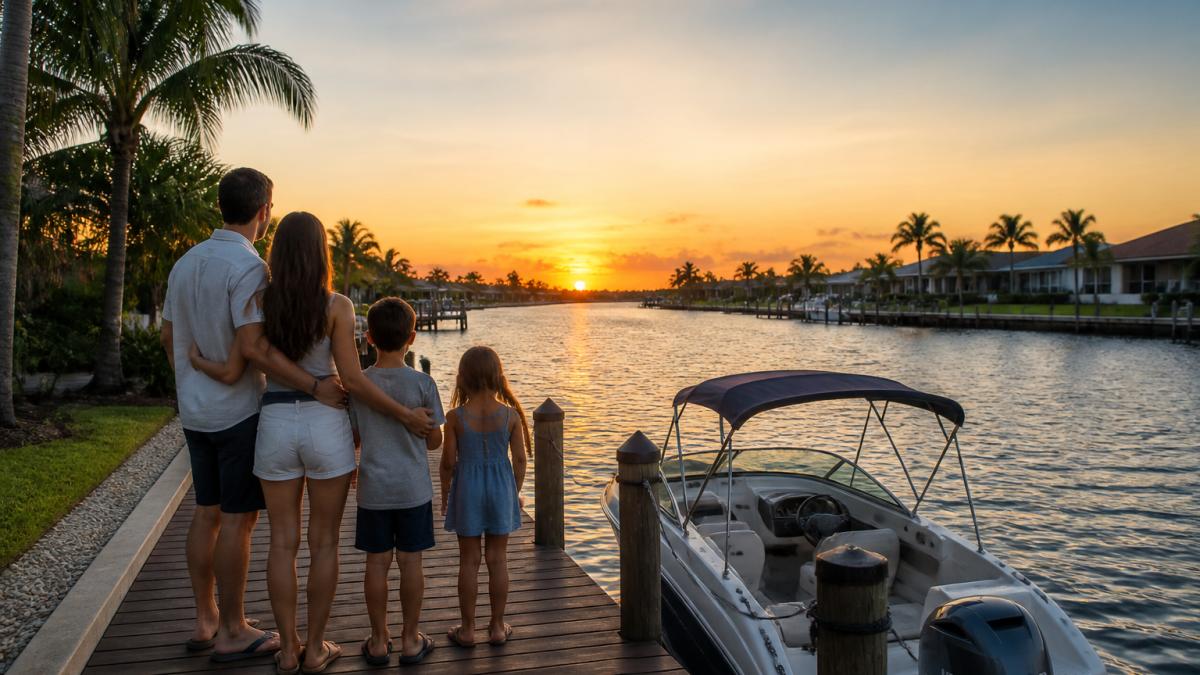
Two categories exist:
- Gulf access canals: Navigable all the way to open water. Expect 15 to 45 minutes of idle-speed cruising depending on how far south you are.
- Freshwater canals: Lovely water views, no route to the sea. Fine for kayaking and swimming, useless for a boat you plan to take offshore.
A common mistake is booking a “canal-front” home and assuming it is Gulf access. Check the listing language and ask directly. Cape Coral Vacation Homes & Rentals LLC is an experienced partner in Cape Coral for vacation homes and rentals.
Cape Coral Vacation Rentals with Private Pools: Heated, Saltwater, and Spa Options
Private pools come standard in most Cape Coral vacation rentals, but the type matters more than photos suggest. A screened lanai keeps bugs out and lets you swim in the evening without repellent.
Here is how the options compare:
|
Pool Type |
Best For |
Watch Out For |
|---|---|---|
|
Heated pool |
Winter and snowbird stays |
Confirm the heating fee upfront |
|
Saltwater pool |
Sensitive skin, gentler feel |
Still chlorinated, just differently |
|
Spa or hot tub |
Evening relaxation, adults |
Ask if it heats independently |
|
Unheated pool |
Summer trips |
Water can be too warm in August |
Heated pools matter from roughly November through March. Ask whether heating is included or billed separately, because this is one of the most common surprise charges in the market.
Cape Coral Vacation Homes with Boat Docks: Dockage, Canal Width, and Bridge Clearance
Boat docks turn a rental into a boating base, but not every dock fits every boat.
Dockage is the linear feet of tie-up space. A 25-foot boat needs a dock rated for at least 30 feet.
Bridge clearance is the one people forget. Some canals route under fixed bridges with limited vertical clearance.
U.S. Coast Guard boating safety resources recommends checking local waterway restrictions before any unfamiliar route.
Cape Coral Vacation Rental Booking Tips: How to Compare Listings and Avoid Surprises
Booking tips come down to verification. Photos are marketing; details are reality. Compare every home against the same checklist, and focus on the numbers that actually decide your trip: total cost and fine print.
Understand the real cost drivers
Nightly rates vary widely by season, canal access, and home size. A few cost drivers matter most:
- Seasonality: Winter and spring (roughly January through April) command the highest rates, especially for homes with heated pools and Gulf access. Summer and fall are often cheaper, though school-break demand can spike.
- Pool heating: Many homes charge a separate daily or weekly fee from November through March. Ask whether it is included or billed separately, and whether it covers the entire stay.
- Cleaning and departure fees: Usually fixed per stay, so they hit shorter bookings harder, a three-night stay may carry the same cleaning fee as a two-week stay.
- Taxes and resort fees: Florida vacation rentals are subject to state and local taxes, and some communities add a resort or service fee. Ask for the full quote, not just the nightly rate.
- Pet fees and deposits: If you are traveling with a pet, confirm the pet policy and any non-refundable pet fee before booking.
The lowest nightly rate is rarely the lowest total cost. Always request a full quote including taxes, cleaning, pool heat, and pet fees.
Rental policies and total-trip logistics
Beyond price, policies determine whether a home fits your group. Ask before you commit:
- Minimum stay: Many Cape Coral homes require three to seven nights, sometimes longer in peak season. If you need a shorter stay, ask directly.
- Deposits and cancellation terms: Policies vary. Understand what triggers a refund and what does not, especially for weather-related cancellations.
- Check-in and check-out: Confirm times and whether early check-in or late check-out is possible. This matters if you are coordinating flights or a boat delivery.
- Accessibility and practical details: Ask about stairs, door widths, grab bars, parking, laundry, and kitchen equipment, these determine whether a home works for a group with mobility needs or a large family.
- Pool heating and spa operation: If the home has a spa or hot tub, ask whether it heats independently and whether there is an extra charge.
Compare listings side by side
Use this framework to compare homes on the same criteria:
- Confirm Gulf access versus freshwater canal
- Verify dock length and bridge clearance for your boat
- Ask whether pool heating is included or extra
- Check the actual bed count, not just “sleeps 12”
- Confirm cancellation terms and any cleaning fees
- Request a full quote including taxes and fees
For longer stays, ask about weekly and monthly pricing directly. Nightly rates rarely reflect what a three-week or four-month booking costs, and many owners offer extended-stay discounts you have to ask for.
Florida Department of Revenue vacation rental tax information provides details on state and local taxes that may apply to your stay.
Neighborhood and Location Guide: Southwest Cape, Southeast Cape, and Canal Systems
Location shapes your trip more than any single amenity. Cape Coral splits into four quadrants, each with a different feel, canal profile, and distance to open water. The quadrant name alone does not tell you how long it takes to reach the Gulf, where the nearest grocery store is, or whether your boat can clear the bridges. Here is a practical guide.
Southwest Cape: closest to the river and Gulf route
Southwest Cape sits closest to the Caloosahatchee River and the main route to the Gulf. Canals here tend to be wider and more direct, shortening your cruise to open water, often the most convenient quadrant for boaters.
- Typical Gulf access time: From many Southwest Cape canals, expect 15 to 30 minutes of idle-speed cruising to reach the river, then additional time to reach the Gulf depending on your destination.
- Canal characteristics: Wider canals, fewer tight turns, and more direct routes. Some canals still have bridges, so check clearance.
- Nearby services: Easy access to Cape Coral Parkway, which has grocery stores, restaurants, and marinas. The Cape Coral Yacht Club area is nearby.
- Best for: Boaters who want the shortest run to open water, and travelers who want to be close to waterfront dining.
Southeast Cape: quieter residential feel with Gulf access
Southeast Cape offers similar Gulf access with a quieter residential feel and good proximity to the Cape Coral Parkway corridor. It is often a good choice for families who want a calmer neighborhood but still want to be on the water.
- Typical Gulf access time: Similar to Southwest Cape, but depending on the canal, you may have a slightly longer run to the river.
- Canal characteristics: A mix of wide and narrow canals. Some areas have more bridges, so verify clearance if you have a tall boat.
- Nearby services: Close to Cape Coral Parkway and Del Prado Boulevard, with shopping, dining, and medical facilities.
- Best for: Families and groups who want a quieter stay with boating access.
Northwest and Northeast Cape: value and freshwater canals
Northwest and Northeast Cape include many freshwater canals and newer construction. These areas often offer great value, but confirm access before booking if boating to the Gulf is the point of your trip.
- Typical Gulf access time: Many homes here do not have Gulf access. If they do, the run can be significantly longer, sometimes over an hour.
- Canal characteristics: More freshwater canals, which are fine for kayaking and swimming but not for offshore boating. Some newer developments have wider canals.
- Nearby services: Growing commercial areas along Pine Island Road and Del Prado Boulevard. Less immediate access to the river.
- Best for: Travelers who do not need saltwater access, want newer homes, or are looking for lower rates.
How to choose your quadrant
Match the quadrant to your priority:
- Shortest run to the Gulf: Southwest Cape.
- Quiet streets with Gulf access: Southeast Cape.
- Value and newer construction without boating needs: Northwest or Northeast Cape.
A five-minute walk to a marina or waterfront restaurant is a real perk, but check the map. Cape Coral is large, and “centrally located” depends on which bridge you need. Use a mapping tool to measure drive times to the airport, beaches, and attractions you plan to visit.
City of Cape Coral canal and waterways information maintains resources on the city’s extensive canal network, including maps and maintenance schedules.
Conclusion: Choosing the Right Cape Coral Waterfront Vacation Home Rental
The hard part is not finding a waterfront home.
Cape Coral Vacation Homes & Rentals LLC specializes in high-quality vacation villas and professional property management across Cape Coral, with a portfolio of homes suited to families, groups, and long-stay snowbirds.
Get started with Cape Coral Vacation Homes & Rentals LLC and book a waterfront stay where the details are verified before you arrive.
Frequently Asked Questions
What should I look for in a Cape Coral waterfront vacation rental?
Focus on four things: canal width and bridge clearance if you plan to boat, whether the pool is heated and how it is heated, the number of bedrooms and bathrooms against your group size, and the actual dock setup. Check whether the dock has a lift, what weight it supports, and how many minutes it takes to reach open water.
What does Gulf access mean for a Cape Coral vacation home?
Gulf access means the home sits on a canal system that connects to the Caloosahatchee River and then to the Gulf of Mexico without needing a boat lift or trailer. Not all waterfront homes have it. Some sit on freshwater canals or are blocked by bridges too low for taller boats. Confirm the specific route, any bridge heights along the way, and roughly how long the boat ride takes to reach open water before you book.
How can I tell whether a Cape Coral rental is suitable for boating?
Ask the property manager for canal width, bridge clearance, and dock dimensions in writing. Canal widths in Cape Coral vary, and some narrower canals limit turning room for larger boats. Check whether the dock has a lift, whether power and water are available at the dock, and whether the canal is a dead end or a through-route.
How far in advance should I book a Cape Coral waterfront rental?
For peak season, which runs roughly January through April, book three to six months ahead for a one-week stay. For monthly or seasonal stays of four weeks or longer, start looking six to twelve months out, since snowbirds often rebook the same property year after year. Summer and early fall offer more availability and shorter lead times, though hurricane season runs June through November and can affect plans.