

Table of Contents
- Why Vacation Rental Maintenance Decides Your Reviews
- Your Vacation Rental Maintenance Checklist by Frequency
- A Repair Triage System: What Waits and What Doesn’t
- Saltwater Pool Maintenance Tips for Gulf Coast Rentals
- Seasonal Home Care for Cape Coral Rentals
- Maintenance Budgeting, Documentation, and Guest Communication
- Conclusion: Protect the Property, Protect the Bookings
- Frequently Asked Questions
Last Updated: October 6, 2026
Why Vacation Rental Maintenance Decides Your Reviews
Vacation rental property maintenance tips matter most in the first hour of a guest’s stay, and the best vacation rental property maintenance tips start with function.
At Cape Coral Vacation Homes & Rentals LLC, we manage waterfront villas with saltwater pools, private docks, and screened lanais.
That is why maintenance is not a chore list. It is your booking engine.
Below is a maintenance schedule, plus a repair triage system and a budgeting approach that can help owners stay ahead of surprise costs.
Guests forgive dated furniture. They do not forgive a broken AC in August. Fix function first, style second.
Your Vacation Rental Maintenance Checklist by Frequency
A vacation rental maintenance checklist works best when you sort tasks by frequency. Daily and turnover tasks protect the guest experience; monthly, quarterly, and annual tasks protect the property itself. Here is the framework we follow:
| Frequency | Focus | Who Handles It |
|---|---|---|
| Between guests | Cleaning, restocking, quick checks | Cleaning crew |
| Monthly | Fixtures, filters, safety items | Property manager |
| Quarterly | Deep systems, appliances, exterior | Maintenance vendor |
| Annually | Roof, HVAC service, dock, pool equipment | Licensed trades |
The logic is simple. The more often a task runs, the cheaper it is to fix when something slips.
Between-Guest Turnover Tasks
Turnover is your best maintenance window. A crew is already inside, so add 15 minutes of inspection to every clean.
Between-guest tasks should cover:
- Test every faucet, showerhead, and toilet for leaks or weak flow
- Check under all sinks for moisture and soft cabinet floors
- Run the dishwasher and washing machine on a short cycle
Small leaks under a sink are the classic hidden problem. A drip that runs two weeks can rot a cabinet base and warp flooring. Catch it at turnover and you replace a washer; miss it and you replace a cabinet.
Monthly and Quarterly Inspections
Monthly inspections catch the slow stuff: filters, seals, and safety gear. Quarterly inspections go deeper into home systems.
A monthly walkthrough should include:
- Swap or rinse HVAC filters
- Test smoke and carbon monoxide alarms
- Check showerheads and faucets for mineral buildup
Quarterly, bring in a vendor for:
- Flushing the water heater and checking the anode rod
- Servicing the AC unit and clearing the condensate line
- Inspecting the roof, siding, and gutters
A clogged AC condensate line is the number one cause of summer water damage in Florida rentals. It drips slowly into the ceiling and shows up as a stain weeks later. Have it cleared every quarter.
A Repair Triage System: What Waits and What Doesn’t
Not every repair deserves the same response time. A triage system keeps your crew calm and your guests happy.
We sort repairs into three levels:
Level 1: Fix now. No hot water, no AC, no power, a water leak, a broken lock, or a pool that cannot be used. These get a same-day response. Guests cannot enjoy the home without them.
Level 2: Fix within 48 hours. A slow drain, a noisy appliance, a broken ice maker, a flickering light, or a wobbly ceiling fan.
Level 3: Schedule it. Cosmetic wear, a scuffed wall, a worn patio cushion, or a faded deck stain.
The payoff is real. When a guest reports a problem, you can tell them exactly when help arrives.
Keep a written vendor list for each trade: plumber, electrician, AC tech, pool service, and handyman. Call the first name, text the second. In peak season, everyone is busy, so a backup plan is not optional.
Saltwater Pool Maintenance Tips for Gulf Coast Rentals
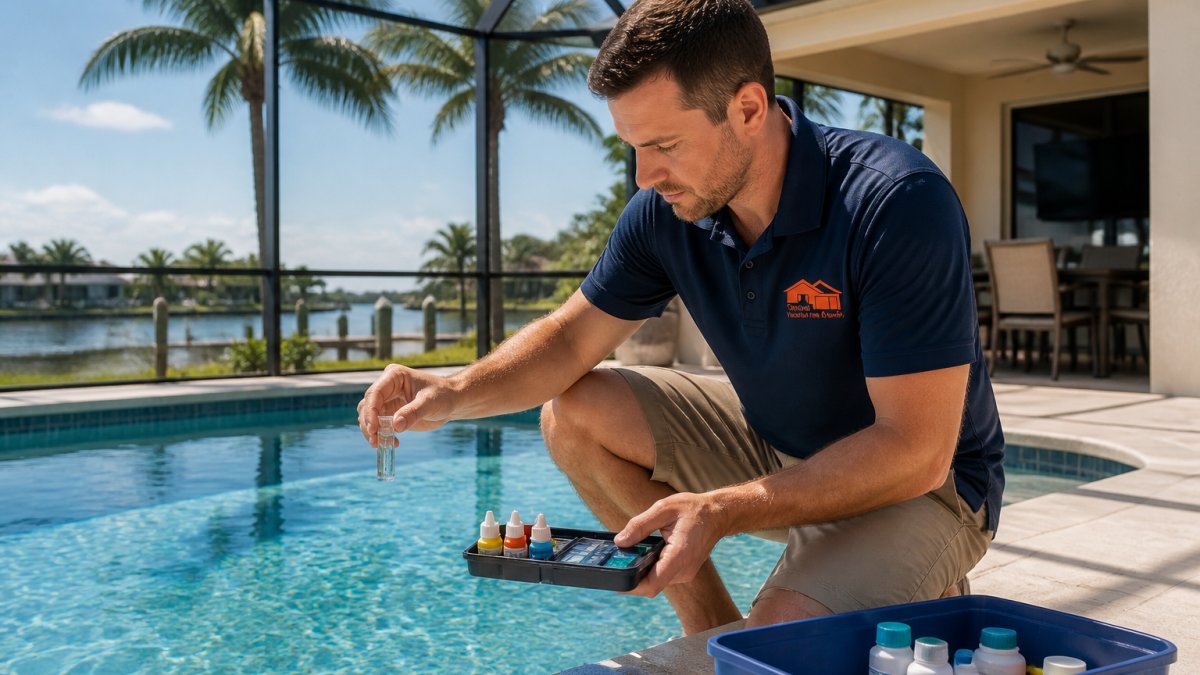
Saltwater pool maintenance tips start with one correction: a saltwater pool is still a chlorine pool. The salt cell turns salt into chlorine, so you are not skipping chemistry, you are changing how you add it.
Why Gulf Coast Saltwater Pools Behave Differently
A pool in Cape Coral or anywhere along the Southwest Florida coast faces four pressures an inland pool does not:
- Summer rain. Afternoon storms dilute salt and chlorine and shift pH. A pool that tested perfectly on Monday can be under-sanitized by Wednesday.
- Heat and sun. UV burns off free chlorine faster, and warm water grows algae faster. Summer demand can double compared to winter.
- Salt air and salt water. Coastal air accelerates corrosion on handrails, ladder bolts, light fixtures, and pump housings. Saltwater pools add a second corrosion source on top of the marine environment.
The Gulf Coast Saltwater Pool Schedule
For our waterfront villas, we run the pool on a set schedule that flexes with the season:
- Test free chlorine, pH, and salt levels twice a week in summer, once a week in cooler months
- Clean the salt cell every three months, or sooner if you see scale on the plates
- Rinse the cartridge filter every two weeks and replace it yearly
Heavy guest use raises chlorine demand fast: a full house swimming all day burns through sanitizer much quicker than a family of four. After every checkout we skim, check chemistry, and check pump pressure. High pressure means a dirty filter, and a dirty filter means cloudy water by the next check-in.
Saltwater Pool Chemistry, in Plain Terms
You do not need to be a chemist, but you do need to know what each reading tells you:
- Free chlorine is the sanitizer actively killing contaminants. If it reads low, the salt cell is not keeping up, the cell needs cleaning, or the water needs a shock.
- pH controls how well chlorine works and how comfortable the water feels. High pH reduces chlorine effectiveness and can cause scale. Low pH corrodes metal and irritates skin and eyes.
- Salt level is the raw material for the cell. Too low and the cell cannot produce chlorine. Too high and you risk corrosion and taste complaints.
A salt cell that reads “good salt, no chlorine” is almost always a dirty or failing cell, not a chemistry problem. Clean the cell first, retest, and only then consider replacement.
Pool Equipment and the Waterfront Setting
A waterfront villa adds equipment most pool guides never mention: docks, boat lifts, seawalls, and screened lanais. Each interacts with the pool system.
- Dock and boat lift. Fuel, oil, and marine growth can wash into the pool area during storms. Keep the pool deck drainage clear and check the lift after every major rain.
- Seawall and decking. Salt spray and pool splash both accelerate corrosion on fasteners and railings. Inspect them together, not separately.
- Screened lanai. Screen panels trap debris and reduce airflow, which can raise humidity around the pool equipment. Clear debris after storms and check the pump area for standing water.
A clogged AC condensate line is the number one cause of summer water damage in Florida rentals, and a salt cell that stops producing chlorine is the number one cause of a green pool by check-in. Both are preventable with a fixed schedule.
Long-Stay Guests and the Pool
Four- and eight-week guests use the pool differently than a weekend guest: they swim daily, host family, and notice small changes in water clarity before you do. For long stays we add a mid-stay pool check, which catches a drifting pH or slow filter before it becomes a complaint and gives guests a chance to ask for anything they need.
A saltwater pool still needs weekly testing, a clean salt cell, and a schedule built for Gulf Coast heat, rain, and salt air. Treat it like a chlorine pool with a different delivery system, and treat the waterfront setting as part of the system.
::: Consistent attention to these environmental factors ensures that your pool maintenance schedule remains effective throughout the most demanding months of the year.
Seasonal Home Care for Cape Coral Rentals
Seasonal home care for Cape Coral rentals follows the Gulf Coast calendar, not the calendar most guides use.
That shapes the maintenance year:
Fall (October to November): Service the AC before heavy use. Check the pool heater. Inspect the roof and gutters before the rainy season ends. Test the dock and boat lift if the home has water access.
Winter (December to March): This is peak booking season. Stick to turnover checks and quick fixes.
Spring (April to May): Deep clean the AC coils. Flush the water heater.
Summer (June to September): Watch for storm damage, mold, and humidity.
Long-term guests on four- or eight-week stays need a different rhythm.
Maintenance Budgeting, Documentation, and Guest Communication
Most owners underwrite maintenance as a single line item, then get surprised when the AC dies in July and the pool heater fails in December. A better model treats maintenance as four separate reserves, each funded on its own clock, the framework we use across our Cape Coral waterfront villas, and the part most owners skip.
Four Reserves, Four Clocks
| Reserve | What It Covers | Funding Cadence | How to Size It |
|---|---|---|---|
| Turnover care | Cleaning, laundry, pool service, lawn, filters, restocking | Every booking | Per-turnover cost multiplied by expected bookings |
| Wear and tear | Faucets, seals, bulbs, paint touch-ups, patio cushions, screen repairs | Monthly | A small fixed monthly transfer |
| Big systems | HVAC, water heater, roof, dock, boat lift, pool pump and salt cell | Yearly | Annualized replacement cost of each system, divided by its expected service life |
| Emergency | Storm damage, burst pipe, failed AC, pool equipment failure | Always funded | A standing reserve you do not touch for routine work |
The sizing logic is simple. A roof that lasts 20 years and a water heater that lasts 10 years each get their own annualized number; add them together for your yearly big-systems reserve.
A common pattern among experienced operators is to set the emergency reserve first, then fund the other three from booking revenue. If a month is slow, the emergency reserve stays intact.
Do not fund big-system reserves from a single busy month. Hurricane season, peak snowbird season, and summer storms all cluster. A reserve that depends on one good month will fail in the month you need it most.
Documentation That Protects You Three Ways
A maintenance log is not paperwork for its own sake. It does three jobs: it proves work was done, shows guests and platforms you respond fast, and gives you a repair history when you sell the home or file an insurance claim.
Keep one log per property, digital or paper, with these fields:
- Date and time the issue was reported
- Who reported it (guest, cleaner, inspector, owner)
- Description of the issue and the room or system involved
The recurring-issue column is the one most owners ignore, and it is the most valuable. If the same guest bathroom drain clogs three times in a year, the log tells you it is a plumbing design problem, not a guest problem, the difference between fixing a symptom and fixing a cause.
A Guest Reporting Workflow That Saves Reviews
Guests do not report problems the way owners expect. They mention them in passing, save them for the review, or message the booking platform instead of you. A short, repeatable workflow closes that gap.
- Set the channel. Put a single reporting method in the check-in message, one phone number or one message thread. Multiple channels create missed messages.
- Acknowledge within minutes. Even if the fix takes two days, a reply within minutes changes the guest’s entire experience of the problem.
- Triage and assign. Sort the issue into fix-now, fix-within-48-hours, or schedule-it, then assign the named vendor for that trade.
- Confirm the visit window. Tell the guest the day and the time block, not just “soon.”
- Follow up after the repair. A short message asking if everything is working now turns a complaint into a five-star mention.
Add a one-line “how to report an issue” note to your check-in message and your house manual. Guests who know the process report problems early instead of saving them for a review. On four- and eight-week stays, this matters even more, a small issue left unmentioned for a month becomes a large one.
Vendor Coverage During Peak Season
Documentation and budgeting only work if someone can actually do the repair. In peak season, every plumber, electrician, and AC tech in a coastal market is booked. Build your vendor list before you need it:
- Name a primary and a backup for each trade: plumber, electrician, HVAC, pool service, handyman, roofer, and dock or marine contractor
- Confirm each vendor’s after-hours policy and whether they serve rentals
- Share your property access details and gate codes in advance so no visit is delayed
A written vendor list with backups is the single cheapest insurance policy in vacation rental maintenance. It costs nothing to build and protects every booking on your calendar.
Conclusion: Protect the Property, Protect the Bookings
Every booking rests on a property that works. Clean filters, tight faucets, a balanced pool, and a fast repair response keep guests returning and reviews strong. Maintenance is the quiet engine behind all of it.
That is the work we do every day at Cape Coral Vacation Homes & Rentals LLC. For travelers, our villas like Villa High Tide and Villa Turtle Paradise offer waterfront stays with saltwater pools, and we welcome long-term bookings of four or eight weeks.
Book our luxury vacation homes in Cape Coral and let us handle the details.
Frequently Asked Questions
What is the 1% rule for property maintenance?
The 1% rule suggests setting aside roughly 1% of a property’s value each year for maintenance and repairs. The figure is a planning baseline, not a guarantee: saltwater pools, docks, and heavy seasonal occupancy push some waterfront villas higher. Track real repair costs for a year, then adjust the reserve to match your property instead of the rule.
How often should vacation rentals undergo professional inspections?
Walk the property after every guest checkout, run a deeper inspection monthly, and bring in licensed trades for HVAC, electrical, and pool systems annually. In Cape Coral, add a pre-season inspection before winter bookings fill and a post-storm check after any named system passes through. Frequent documented inspections catch small leaks and worn fittings before they become guest complaints or emergency repair bills.
What maintenance tasks are essential for saltwater pools in Cape Coral?
Test salinity, pH, and stabilizer weekly; clean the salt cell every three to four months; and check the pump, filter, and skimmer baskets for debris. Heavy summer rain dilutes salt levels, so retest after storms. Keep the pool deck and screen enclosure clear, and log every reading so you can spot drift early. A well-kept saltwater pool is one of the strongest review drivers for waterfront villas.
What’s the most overlooked home maintenance task in a vacation rental?
The kitchen hood vent and other hard-to-reach areas. Grease builds up in the hood filter, and ceilings, ceiling fans, and vent covers collect dust that guests notice immediately. Add hood filter cleaning to the monthly list and wipe high surfaces during deep cleans. These small tasks cost little time but prevent odors, fire risk, and the kind of visible neglect that shows up in negative reviews.