

Table of Contents
- Why Avoiding Vacation Rental Booking Scams Matters More Than Ever
- What You’ll Need Before You Start Booking
- Vacation Rental Red Flags That Signal Trouble
- How to Verify Vacation Rental Listings Step by Step
- Secure Payment Methods for Vacation Rentals
- Common Mistakes That Make Travelers Vulnerable
- What to Do If You Suspect a Vacation Rental Scam
- Conclusion: Book with Confidence, Not Caution
- Frequently Asked Questions
Last Updated: October 7, 2026
Why Avoiding Vacation Rental Booking Scams Matters More Than Ever
Avoiding vacation rental booking scams starts with one hard truth: a fake listing can look flawless. The photos are bright. The price feels fair. The host replies fast. Then the money is gone.
This guide from Cape Coral Vacation Homes & Rentals LLC is written for families, groups, and snowbirds booking along the Florida Gulf Coast. We rent and manage waterfront villas here, so we see both sides of the market.
Scammers copy real listings and post them on sites that do little checking. They target travelers who book fast and pay fast.
Below, we’ll show you exactly how to spot the fakes and pay safely.
What You’ll Need Before You Start Booking
A short prep list stops most scams before they start. Gather these items first, then start your search.
- The exact dates and number of guests
- A written budget with a small buffer
- The full street address of any home you like
- A saved copy of the listing photos
- A credit card you can dispute charges on
- A phone number for the host or manager
One more thing: slow down. Pressure is a scammer’s main tool.
Save every listing page as a PDF before you pay. If the ad disappears later, you still have proof of what was promised. Banks and card issuers ask for this.
Vacation Rental Red Flags That Signal Trouble
Most vacation rental red flags fall into two groups: how the person talks to you, and what the listing actually says. Learn both.
Pressure Tactics and Unusual Communication
Urgency is the loudest red flag. A real host wants your booking, but not in the next ten minutes.
Watch for these:
- “Three other families are looking at these dates”
- A demand for a deposit within hours
- Refusal to talk by phone or video
- Poor grammar and odd phrasing in messages
- A host who won’t answer simple questions about the home
A real manager answers questions about parking, docks, and check-in without hesitation. We do this every day. It is not hard.
Listing Details That Don’t Add Up
Some fakes are sloppy. Others are nearly perfect copies. Check the details.
- The address doesn’t match the map pin
- Photos appear on other listings under different names
- The home sits in a neighborhood that doesn’t look like the photos
- The price is far below similar homes nearby
- The host asks you to move the chat off the platform
That last one matters. Off-platform chats leave you with no protection.
How to Verify Vacation Rental Listings Step by Step
Learning how to verify vacation rental listings takes about 20 minutes. Do it before you send any money.
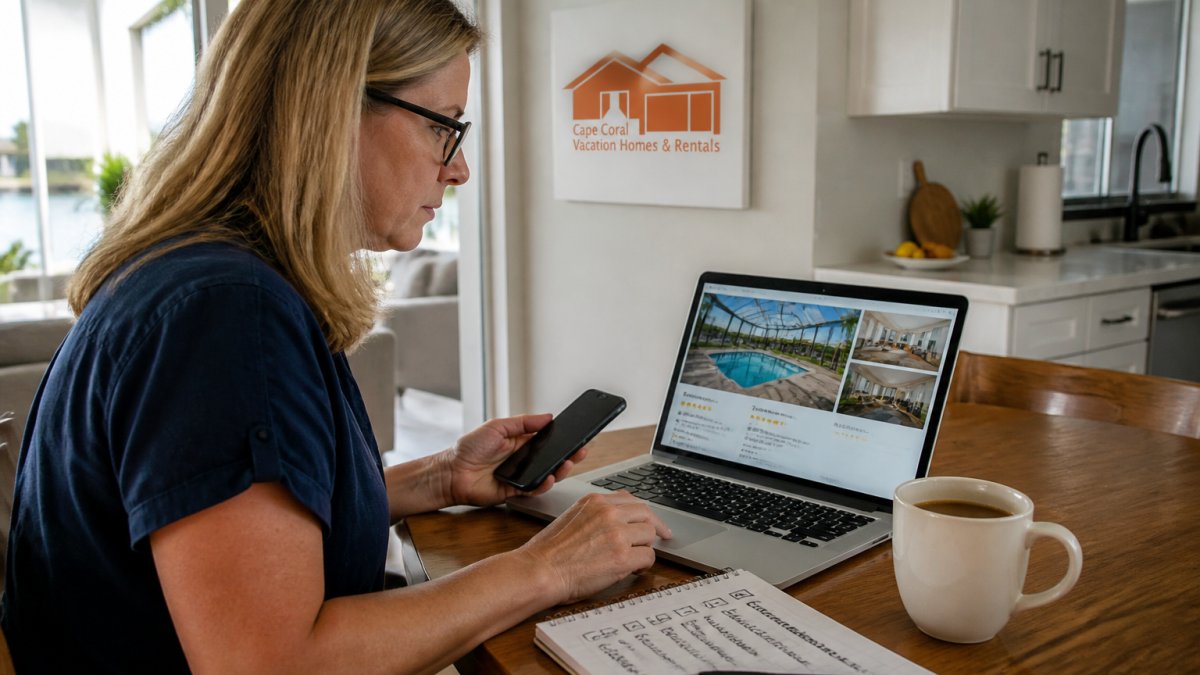
- Search the exact address. Look for the home on map tools and county property records.
- Reverse-search the photos. Upload two or three images to an image search engine.
- Read reviews across sites. Look for the same home under the same manager.
- Call the manager. Use a number from their own website, not the listing.
- Ask for a video walkthrough. A live call is hard to fake.
- Check the registration. Many areas require a rental permit or license number.
- Pay only through the official platform or the manager’s own booking page.
Cross-Checking Photos, Addresses, and Reviews
Start with the photos. If the same kitchen shows up in three different cities, you have your answer.
Next, check the address. County property records are public in most of Florida. They show the owner’s name and the home’s real details.
Reviews need a closer look too. A wall of five-star reviews posted in one week is a warning sign. Real reviews spread out over months and mention small details.
Never pay a deposit by wire transfer, gift card, or payment app to a person you haven’t verified. Once that money leaves, it is almost impossible to get back.
Secure Payment Methods for Vacation Rentals
Secure payment methods for vacation rentals share one trait: they leave a paper trail and a way to dispute.
Use these:
- Credit cards, which let you file a chargeback
- The official booking platform’s payment system
- A written rental agreement before any payment
- A receipt with the company’s full legal name
Avoid these:
- Wire transfers
- Gift cards
- Cryptocurrency
- Payment apps sent to a personal account
Ask for the rental agreement first. A real manager sends one without fuss.
| Payment Method | Dispute Protection | Scam Risk | Best For |
|---|---|---|---|
| Credit card | Yes, chargeback rights | Low | Most bookings |
| Platform payment | Yes, platform rules apply | Low | Site-listed homes |
| Wire transfer | None | High | Never use |
| Gift card | None | High | Never use |
Why Wire Transfers and Gift Cards Are Risky
Wire transfers and gift cards are the two favorite tools of rental scammers. Both are fast, and both are nearly impossible to reverse.
A wire sends money straight into an account. By the time you realize the home isn’t real, the account is empty. Gift cards are worse. They carry no name and no protection at all.
If a “host” asks for either one, end the conversation. That is not a negotiation. It is a test, and they just failed it.
Common Mistakes That Make Travelers Vulnerable
The biggest mistake is booking on emotion. A dream home at a low price short-circuits good judgment.
Other common slips:
- Skipping the address check because the photos looked great
- Trusting a host who refuses a phone call
- Paying a deposit before reading any agreement
- Ignoring reviews that mention odd check-in stories
- Booking through social media messages alone
What most guides miss is how patient scammers are. They will chat for days to build trust. Time spent talking is not proof of anything.
What to Do If You Suspect a Vacation Rental Scam
Act fast, and act in writing. Speed matters more than politeness here.
- Stop all payments right away
- Call your bank or card issuer and dispute the charge
- Report the listing to the platform
- Save every message, photo, and receipt
- File a report with the FBI Internet Crime Complaint Center
- Report identity theft concerns to the Federal Trade Commission
The Florida Attorney General’s consumer protection office also takes complaints from travelers. Keep your notes short and factual.
If you booked through a licensed local manager, call them first. A real company will help you sort out what happened.
Conclusion: Book with Confidence, Not Caution
Booking a vacation should feel exciting, not risky. The good news is that a few simple habits, checking the address, verifying the photos, and paying by card, remove most of the danger.
At Cape Coral Vacation Homes & Rentals LLC, we take the guesswork out of the process. Our waterfront vacation homes in Cape Coral, including Villa High Tide and Villa Turtle Paradise, are real, well-kept, and backed by a team that answers the phone. We also welcome long-term stays of four or eight weeks for snowbirds and extended families.
Get started with Cape Coral Vacation Homes & Rentals LLC and book a saltwater pool villa with confidence.
Frequently Asked Questions
How can I verify a vacation rental listing is legitimate?
Start by reverse-searching the listing photos to see if they appear on other sites. Check that the property address exists on a map and matches the description. Look for a professional management company with a verifiable business registration, like an LLC. Call the local phone number and ask specific questions about the property. Legitimate operators, such as Cape Coral Vacation Homes & Rentals LLC, welcome questions and can provide details about the home, dock access, and amenities.
What are the red flags of a vacation rental scam?
Watch for prices that seem too low for the area or season, pressure to book immediately, requests to pay by wire transfer or gift card, and hosts who refuse a phone call or video tour. Listings with only a few vague photos, no reviews, or a generic description are also risky. If the host asks you to communicate off the platform or send a deposit to a personal account, treat it as a major vacation rental red flag.
Should I pay for a vacation rental with a wire transfer?
No. Wire transfers are almost impossible to reverse, and scammers often insist on them. Instead, use secure payment methods for vacation rentals like credit cards, which offer fraud protection and chargeback rights. If a host or platform only accepts wire transfers, gift cards, or cryptocurrency, walk away. Legitimate companies accept traceable payments and provide a written rental agreement.
What should I do if I suspect a vacation rental listing is a scam?
Stop all communication and do not send money. Report the listing to the platform where you found it and to the FTC at ReportFraud.ftc.gov. If you paid by credit card, contact your card issuer immediately to dispute the charge. Save all messages, emails, and listing screenshots as evidence. Then restart your search using verified local management companies that offer secure booking processes and clear contracts.