

Table of Contents
- How Cape Coral Vacation Rental Maintenance Response Actually Works
- Emergency Maintenance Response Time: What Counts as Urgent
- The Vacation Rental Maintenance Checklist for Every Turnover
- Preventative Maintenance for Florida Vacation Homes
- Guest Communication Templates for Repairs
- Vendor Coordination and After-Hours Coverage in Cape Coral
- Frequently Asked Questions
Last Updated: October 16, 2026
How Cape Coral Vacation Rental Maintenance Response Actually Works
Cape Coral vacation rental maintenance response is the system a property manager uses to receive a repair request, sort it by urgency, and get the right tradesperson to the home before it ruins a guest’s stay. At Cape Coral Vacation Homes & Rentals LLC, we treat every request as a two-part job: fix the problem, and keep the guest informed while it happens.
That second part is where most rentals fall apart.
A guest can forgive a broken ice maker. They will not forgive three days of silence. So we built our process around updates, not just repairs.
Here is the full picture:
- How to tell an emergency from a routine repair
- What to check at every turnover
- How to prevent Florida heat and storms from causing failures
- What to actually say to guests
- How to line up vendors before you need them
Below, we break down each step the way we run it across our Cape Coral villas.
According to FEMA’s guidance on preparing rental property for storms, the first hours after damage are when small problems become expensive ones. That is exactly why response time matters more than almost anything else in this business.
Maintenance response is a communication job as much as a repair job. Guests remember how fast you answered, not how fast the part arrived.
Emergency Maintenance Response Time: What Counts as Urgent
Emergency maintenance response time is the window between a guest reporting a problem and someone taking action on it. In our homes, that window is short. But “emergency” has to mean something specific, or everything becomes one.
Safety issues vs. routine repairs
A safety issue gets an immediate response, any hour. Routine repairs get scheduled during normal working hours.
Safety issues include:
- No air conditioning in summer heat
- Gas smell, smoke, or burning odor
- No water, or water where it should not be
- Sewage backup
- Broken locks, doors, or windows
- Electrical sparking or a dead panel
- Pool water that looks unsafe to enter
Routine repairs can wait for a scheduled visit:
- A dripping faucet
- A slow drain
- One burned-out light
- A wobbly chair or loose handle
- A TV remote that needs new batteries
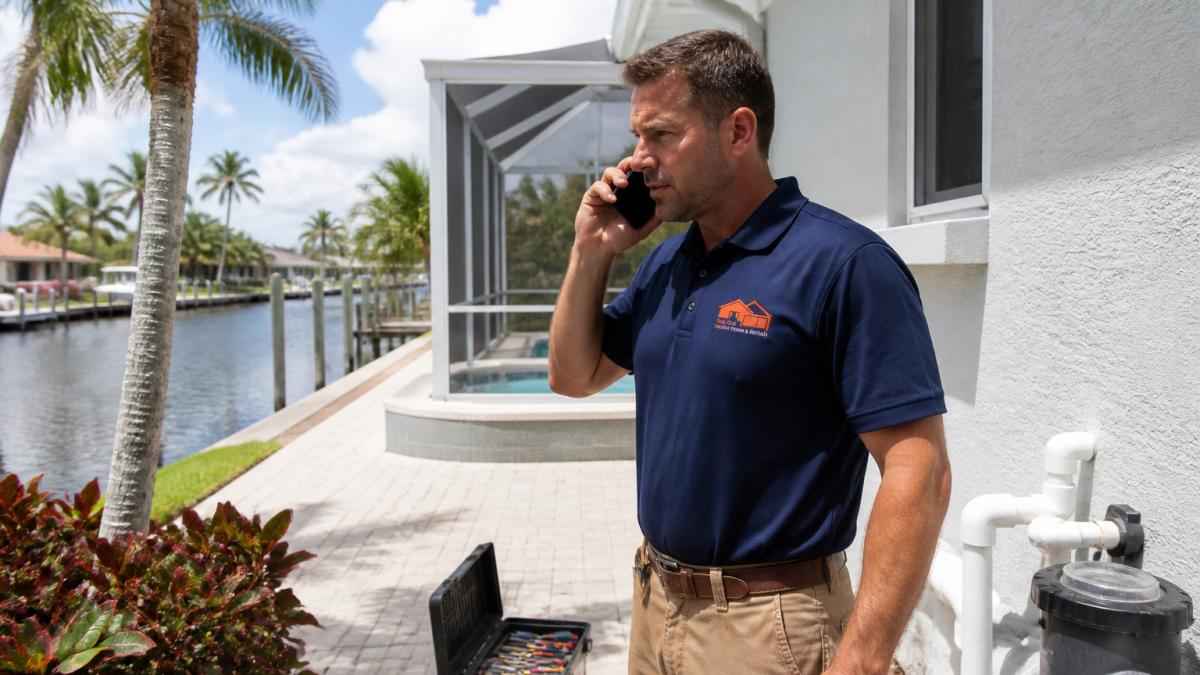
Never let a guest decide what counts as an emergency. If you ask “is it urgent?”, every answer is yes. Publish your own severity list and use it.
The Vacation Rental Maintenance Checklist for Every Turnover
A vacation rental maintenance checklist is the short list of checks a cleaner or inspector runs between guests. It catches small problems before the next family walks in. In Cape Coral, that checklist has to account for salt air, canal-front exposure, and a climate that punishes anything left unattended for a week.
Most turnover checklists stop at “test the AC and run the faucets.” That is not enough here. A waterfront villa with a saltwater pool has systems a inland rental does not: pool chemistry, dock hardware, irrigation, and exterior surfaces that mildew fast in humidity.
Here is the turnover checklist we run across our Cape Coral villas, including Villa High Tide and Villa Turtle Paradise:
Interior systems
- Test the AC and set it to a normal temperature; confirm it holds, not just turns on
- Run every faucet, shower, and toilet; check under sinks for slow leaks
- Check the water heater for leaks and confirm hot water at the farthest tap
- Look for pests, droppings, or ant trails, especially near the kitchen and lanai
- Test all door and window locks, including slider pins and lanai doors
- Replace dead bulbs and batteries; test smoke and CO detectors
- Photograph anything broken and log it before the next guest arrives
- Restock basics: paper goods, soap, trash bags, coffee filters
Waterfront and pool systems
- Confirm the pool pump is running and the saltwater system is reading in range
- Skim the surface and check the water is clear, not cloudy
- Check the dock, ladder, and boat cleats for loose hardware or corrosion
- Inspect the seawall edge for new cracks or erosion after heavy rain
- Confirm irrigation is running and not flooding the lawn or drive
Exterior and storm readiness
- Walk the roof line from the ground for loose shingles or debris
- Clear gutters and downspouts so rain has somewhere to go
- Check lanai screens and pool cage panels for tears or popped fasteners
- Look for mildew on walls, drives, and patio furniture
Turnover checks take minutes and prevent most emergency calls. But a checklist only works if it feeds a response system. When your inspector flags an item, it should enter the same triage path as a guest request: severity, owner, vendor, and close-out. If your cleaner is not doing the checks, you do not have a maintenance system. You have a repair system. Standardizing these workflows ensures that your team remains prepared for sudden equipment failures while maintaining clear emergency repair expectations.
Photograph the pool, dock, and AC at every turnover. A dated photo log settles guest disputes and shows vendors exactly what changed between visits.
Preventative Maintenance for Florida Vacation Homes
Preventative maintenance for Florida vacation homes follows a simple rule: fix things in the off-season so they do not break in season. Heat, salt air, and storms wear a house down faster here than almost anywhere.
What we schedule:
| System | How Often | Why It Matters |
|---|---|---|
| HVAC service | Twice a year | Filters and coils clog fast in Florida |
| Pool and pump check | Weekly | Algae and pump failure ruin a stay |
| Pest control | Monthly | Heat and moisture bring insects in |
| Roof and gutter check | Before storm season | Loose shingles become leaks |
| Exterior wash | Quarterly | Salt and mildew stain walls and drives |
| Lawn and garden care | Weekly in season | Overgrowth looks neglected |
| Dock and seawall check | Quarterly | Water access is a selling point |
The HVAC line is the one owners skip. It is also the one that generates the most emergency calls in July and August.
Book your HVAC service in the shoulder months, not the peak. Every contractor in Southwest Florida is slammed in summer, and a routine tune-up becomes a two-week wait exactly when you need it most.
Guest Communication Templates for Repairs
Guest communication templates for repairs are short, pre-written messages you send when something breaks. They save you from writing under pressure and they keep your tone consistent.
Three templates cover almost everything.
Acknowledgement (send within minutes):
Hi [Guest name], thank you for letting us know about the [issue]. We have logged it and a technician is being scheduled now. I will update you within [timeframe]. If anything changes before then, reply here and I will see it right away.
Scheduled visit:
Hi [Guest name], quick update on the [issue]. Our technician will arrive [day] between [window]. You do not need to be home, but please leave the [area] accessible. I will confirm once the work is done.
Resolved:
Hi [Guest name], the [issue] is fixed. Thank you for your patience, and please let us know if anything else comes up during your stay. We want the rest of your trip to be easy.
Two rules make these work. Give a real timeframe, and never promise a time you cannot keep. A missed window stings more than the original problem.
According to the American Hotel & Lodging Association’s guest service guidance, fast, clear communication after a service failure is one of the strongest drivers of guest loyalty. Vacation rentals are no different.
Vendor Coordination and After-Hours Coverage in Cape Coral
Vendor coordination and after-hours coverage in Cape Coral come down to one thing: relationships built before the emergency. But relationships alone are not a system.
Step 1: Receive the request through one channel.
Guests should have a single contact path: one number or one message thread.
Step 2: Triage by severity.
Use a published severity list, not the guest’s judgment. A common pattern is three tiers:
| Tier | Examples | Target first response | Target on-site |
|---|---|---|---|
| Emergency | Gas smell, no AC in summer heat, active water leak, sewage backup, no power, broken exterior lock | Within minutes, any hour | Same day, often within hours |
| Urgent | No hot water, one non-working toilet, pool pump down, AC running warm | Within a few hours during the day | Within 24 hours |
| Routine | Dripping faucet, slow drain, burned-out bulb, wobbly chair | Same business day | Scheduled within the stay or after checkout |
These targets are not promises to the guest. They are internal triggers that tell you when to escalate. If an urgent request has no vendor assigned by hour four, it moves up the chain.
Step 3: Assign the right vendor.
Keep a short, current list and know who covers what:
- Licensed HVAC contractor
- Plumber
- Electrician
- Pool and saltwater system service
- Pest control
- Handyman for small jobs
- Locksmith
- Exterior and pressure cleaning crew
- Roofer for storm damage
For each vendor, confirm in writing:
- Who to call after hours, and who is the backup
- The response window they commit to
- Gate codes, lockbox info, and access notes shared in advance
- Whether they carry the licensing and insurance your insurer expects
Step 4: Dispatch with context.
Never send a vendor in blind. Send the address, access method, the guest’s description, any photos from the turnover log, and the severity tier.
Step 5: Update the guest while the work happens.
Silence is what turns a repair into a refund request.
Step 6: Close out and document.
Log every job: date, issue, severity, vendor, response time, resolution time, and outcome. Photograph before and after.
After-hours coverage.
For a waterfront villa, after-hours calls cluster around three things: AC failure, water where it should not be, and pool or dock problems.
For guests staying in Villa High Tide or Villa Turtle Paradise, this means one number to call, a clear answer on what happens next, and a team that already knows the home.
Rotate your vendor list once a year and drop anyone who missed two agreed windows. Reliability is the only metric that matters when a guest is waiting.
Frequently Asked Questions
What are the maintenance expectations for vacation rentals in Cape Coral?
Guests expect a working air conditioner, hot water, pool equipment, and clean outdoor spaces from the moment they arrive. Good Cape Coral vacation rental maintenance response covers routine upkeep between stays and a clear path for reporting problems during one. A written vacation rental maintenance checklist, scheduled preventative maintenance for Florida vacation homes, and a documented emergency maintenance response time keep expectations aligned for both guests and owners.
How quickly should a property manager respond to maintenance issues in Florida?
The right speed depends on severity. Safety issues such as a gas smell or exposed wiring warrant an immediate response, while a broken ice maker can wait for the next business day. A practical rule is to acknowledge every maintenance request quickly, then set a fix time based on how much the problem affects guest comfort. Guests should always receive a status update, even when the repair itself takes longer.
What are the common maintenance challenges for waterfront villas in Cape Coral?
Salt air, strong sun, and heavy summer rain wear down pool cages, deck finishes, and exterior paint faster than inland properties. Irrigation systems and pool pumps run hard most of the year. Preventative maintenance for Florida vacation homes should include regular pool service, lawn and garden care, pest control, and exterior cleaning so small issues do not reach guests as urgent repairs.
If the AC breaks during my stay, how fast can it be fixed?
Air conditioning failures in Cape Coral summer heat count as urgent repairs, so a professional manager dispatches a technician the same day and keeps you updated until the system is running. In the meantime, the management team can arrange fans or a temporary solution and adjust your stay if the repair takes longer than expected.